

If your kitchen counter is about three feet of usable space, wedged between a sink and a stove, with a single outlet that has to do double duty for a toaster and a coffee maker, I'd point you toward the DASH Tasti-Crisp Air Fryer over the bigger Ninja air fryers on the market, and I want to walk through exactly why instead of just telling you to trust me. I've cooked in a 500 square foot apartment for twelve years now, narrow galley kitchen, cabinets that are already full, and I've run both machines side by side on my own counter rather than in a test kitchen with unlimited space. The short version is this: the DASH Tasti-Crisp wins on footprint, weight, and how often it actually gets pulled out and used on a weeknight when you're tired. The Ninja wins when you're cooking for a full table and have the counter to match.
I want to be upfront that both machines are genuinely good at making crispy food without a deep fryer. That's not where they differ. Ninja builds reliable air fryers with strong fan power, and depending on the model, digital presets that some cooks love. If I only cared about raw cooking performance for a family of four, I'd probably tell you to go look at Ninja first. But raw performance isn't the only question when your kitchen has three feet of usable counter and a cabinet that's already stuffed with mismatched lids. The real question is what fits, what you'll actually reach for on a Tuesday night, and what doesn't end up stored on top of the fridge collecting dust.
| Spec | DASH Tasti-Crisp | Ninja Air Fryer |
|---|---|---|
| Capacity | 2.6 quarts, sized for 1 to 2 real servings at a time | Typically 4 to 5.5 quarts across most models, built for 3 to 5 servings |
| Counter footprint | About 9 inches wide, fits on a narrow galley counter next to a coffee maker | Often 11 to 13 inches wide with a boxier shape that eats more linear counter space |
| Weight | Roughly 7 pounds, easy to lift into an overhead cabinet with one hand | Commonly 10 to 15 pounds depending on model, harder to store overhead on your own |
| Controls | Simple analog dial for temperature and timer, no menu to navigate | Digital touchscreen with multiple cooking presets and program memory |
| Basket cleanup | Small nonstick basket that rinses clean in about a minute at the sink | Larger basket and crisper plate that take up more sink space and often need a soak |
| Noise level | Steady, quiet hum that doesn't carry through a small apartment | Stronger fan noise, especially noticeable at higher temperatures in a small room |
| Where it lives when not in use | Small enough to stay out permanently on a narrow counter | Bulkier shape usually needs a dedicated cabinet shelf or pantry space |
| Best fit | Studios, one-bedrooms, dorms, and RVs cooking for one or two | Full kitchens cooking for three or more people on a regular basis |
Where DASH Wins
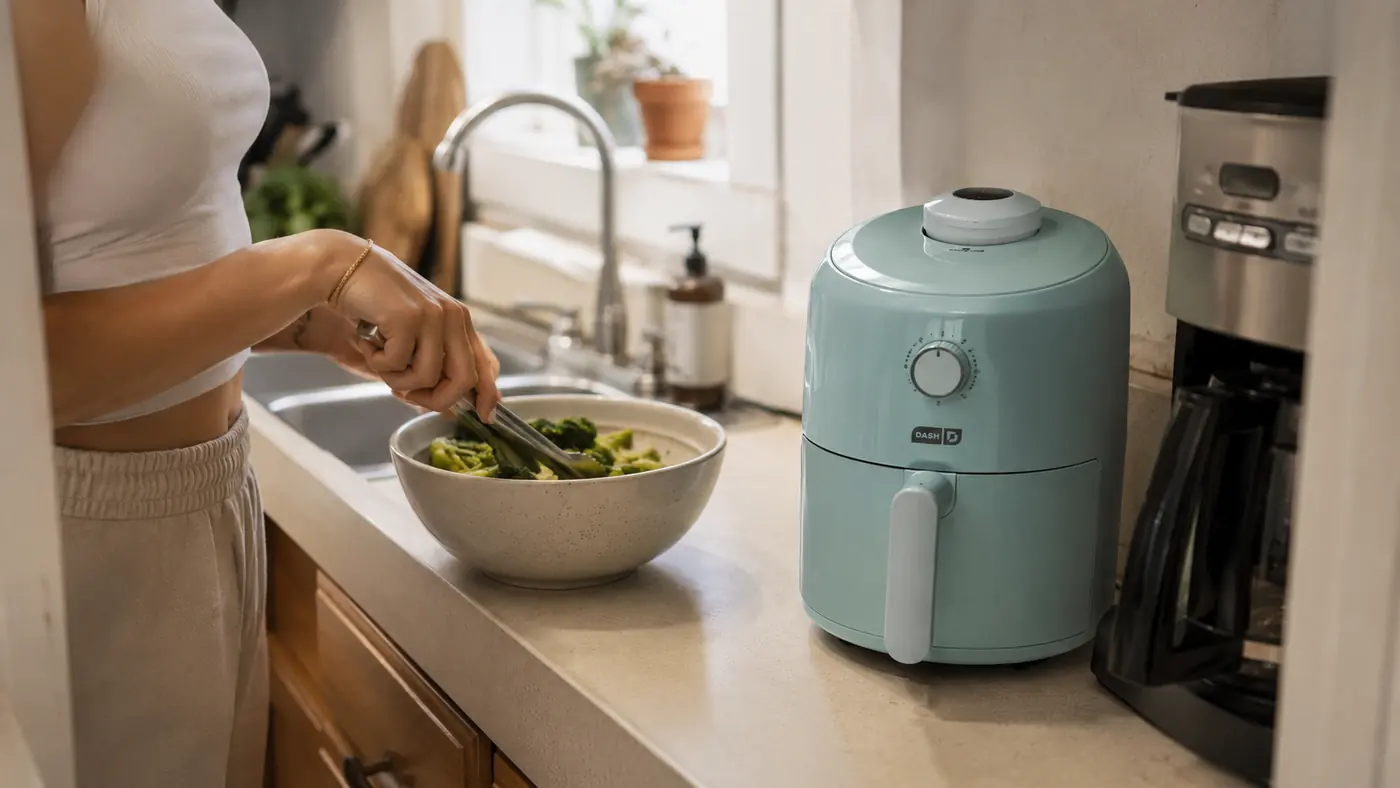
The DASH Tasti-Crisp measures small enough that it lives on my counter permanently, tucked between the coffee maker and the drying rack, without crowding either one. At 2.6 quarts, it's sized for the way I actually cook most nights: a couple of chicken thighs, a handful of frozen fries, four or five brussels sprouts split between me and my partner. I'm not air frying a whole chicken in a 500 square foot apartment, and most people cooking for one or two aren't either, no matter what the marketing photos on a bigger machine show you. The DASH matches the portions I actually make, which means I use it more, which is the whole point of buying a small kitchen appliance in the first place.
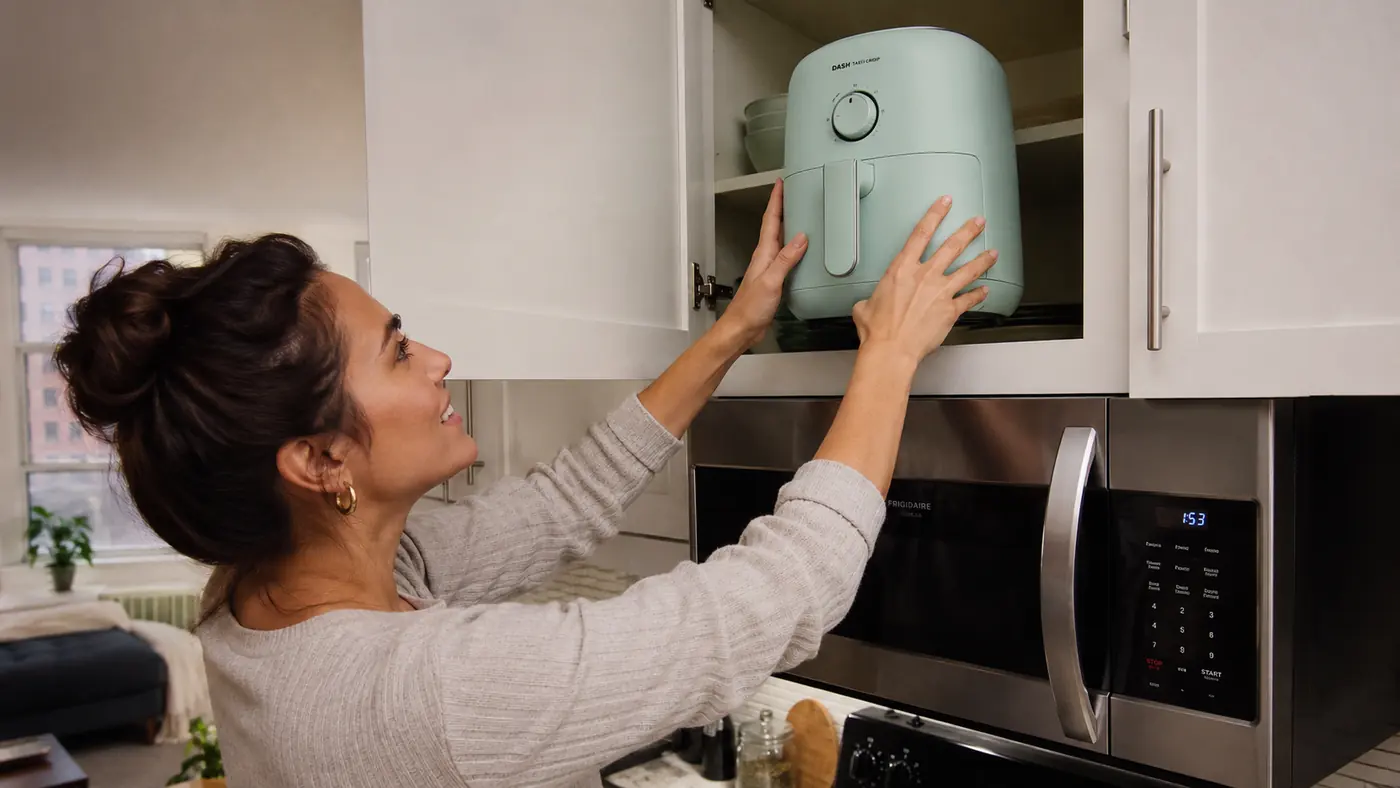
It's also light enough that when I need the counter back for something else, like rolling out dough or unloading a grocery bag, I can lift the DASH into the cabinet above my stove with one hand and not think twice about it. The dial controls matter more than they sound like they should. There's no touchscreen to navigate with greasy fingers at 7pm on a Tuesday, no menu of twelve presets to scroll through when I just want fries in twelve minutes. Turn the dial to temperature, turn the timer, walk away. In a small kitchen, on a tired weeknight, simple beats feature-rich almost every time, and that's the honest reason the DASH gets used more than a bigger machine would in my apartment.
Where Ninja Wins
If you've got a full kitchen and a family to feed, the Ninja's bigger basket is the right call, and I'd rather tell you that plainly than pretend the DASH is the answer for everyone. A 4 to 5.5 quart capacity means you can crisp a full batch of wings or roast a whole tray of vegetables in one round instead of running a smaller basket twice, which matters a lot when you're cooking for four people who are all hungry at the same time. Doing two batches back to back adds real time to a weeknight dinner, and if that's your situation, the Ninja's extra capacity earns its keep.
Ninja's touchscreen and preset programs are also genuinely nice if you like a machine that remembers your settings or want more built-in options tuned to specific foods. Some models add extra connectivity, which some cooks like for tracking recipes and cook times. None of that is a knock on Ninja. If capacity and preset variety matter more to you than counter space and weight, I'd rather point you honestly toward Ninja than talk you into a smaller machine that won't fit how you actually cook every night.
Three Feet of Counter Is Not a Compromise, It's a Constraint
The DASH Tasti-Crisp was built for kitchens like mine, not scaled down from a bigger one. See today's price and current availability before deciding between these two.
Amazon Check Today's Price on Amazon →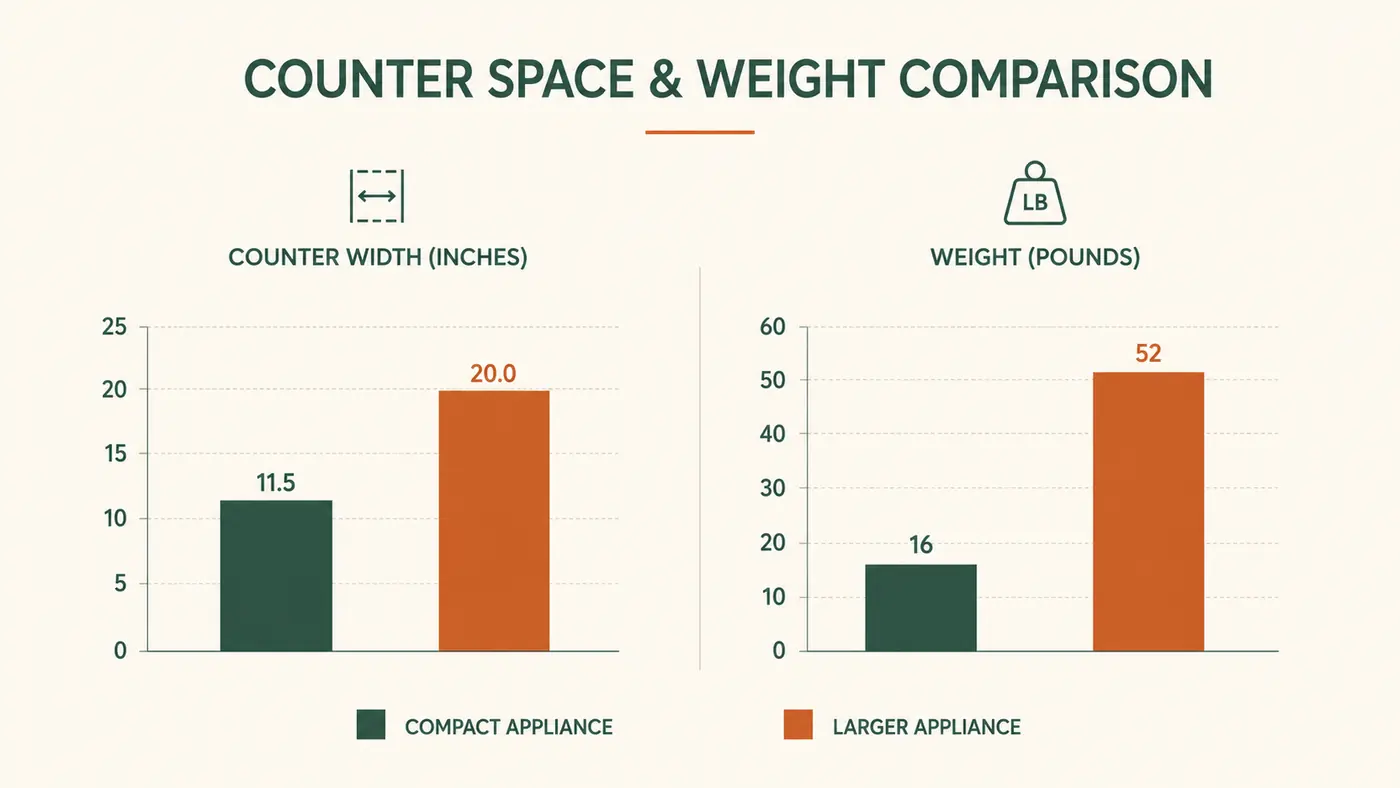
How I Actually Tested Both, Side by Side
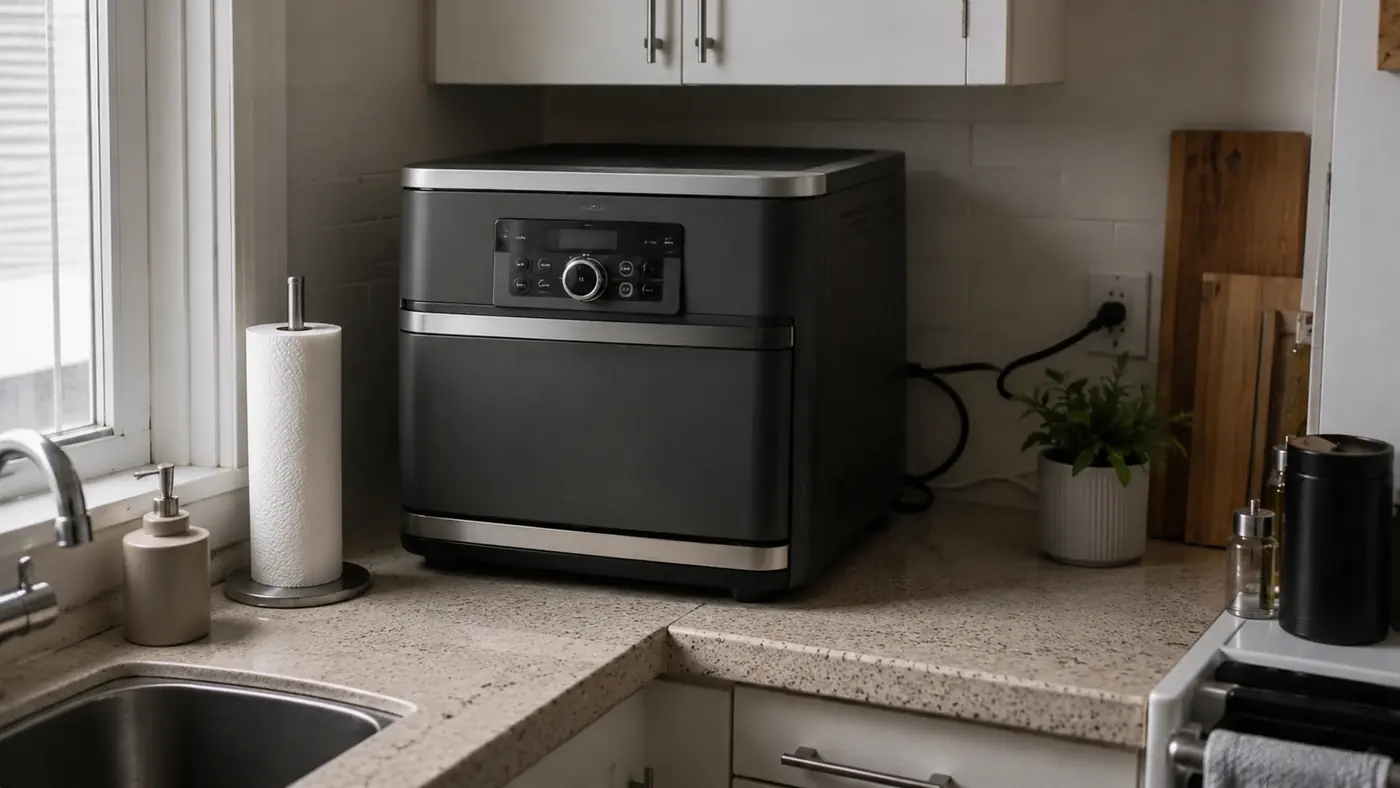
I borrowed a mid-size Ninja from a friend with a bigger kitchen and ran it on my own counter for two weeks before I sent it back, cooking the exact meals I'd normally cook in the DASH: fries, chicken thighs, frozen dumplings, reheated pizza slices. I wasn't comparing spec sheets, I was comparing how each one behaved in the actual footprint I have to work with. The Ninja cooked evenly and browned well, no complaints there. But every single time I used it, I had to move something else off the counter first, usually the dish rack or the cutting board I keep leaned against the backsplash, and every time I finished, I had to decide whether to leave it out or find somewhere to put it away, because it didn't fit in the cabinet space I'd cleared for the DASH.
That friction is the whole story in a way a spec sheet never captures. It's not that the Ninja cooked worse food, it's that using it added a small chore to every meal that the DASH doesn't add. Two weeks in, I caught myself reaching for the stove instead of pulling the Ninja back out, just to avoid the shuffle. That's the pattern I hear about most from readers in small kitchens: the bigger appliance gets used for the first week out of excitement, then it quietly stops getting pulled out because it's a hassle to make room for. A machine that's a little smaller but actually gets used beats a bigger one that ends up back in its box.
Cleanup and Noise: The Stuff Spec Sheets Skip
Spec sheets don't tell you how loud a machine sounds when you're trying to watch something eight feet away in a studio apartment, and they don't tell you how much of your sink a basket eats up on a Tuesday night when the sink is also your only prep space. The DASH's smaller basket rinses clean under the tap in under a minute if I wipe it down right after cooking, no soaking required most nights. The Ninja's larger basket and crisper plate take up nearly my whole sink when I've used one, and the bigger surface area tends to need a longer soak to get stuck-on bits off, which is a bigger deal when you don't have a second sink or a dishwasher to hand it off to.
Noise matters more in a small space than people expect going in. The DASH runs a steady, fairly quiet hum, low enough that I've cooked dinner while my partner was on a work call ten feet away and it never came up as a problem. The Ninja's fan is stronger, which is part of how it moves enough hot air around a bigger basket to cook evenly, but that extra power comes with a noticeably louder pitch, especially once it hits higher temperatures. In an apartment with thin walls or a shared wall with a neighbor, that difference is worth factoring in before you buy.
The DASH matches the portions I actually make, and a machine you'll use every week beats a bigger one gathering dust on top of the fridge.
Apartments, Dorms, and RVs: Where This Comparison Actually Matters
This comparison isn't really DASH versus Ninja in the abstract. It's about matching a machine to the kitchen you actually have. In a dorm room with one outlet and a mini fridge doubling as counter space, a larger Ninja footprint can eat the entire surface you've got, leaving nowhere to set a cutting board or a bowl. In an RV, where every appliance has to earn its storage spot and its weight matters when you're driving, the DASH's smaller size and lighter build make it something you can actually stow in a cabinet without it sliding around on the road. I hear from readers in all three situations, apartments, dorms, and RVs, and the complaint is always the same about oversized appliances: it worked fine in the store, then it got home and there was nowhere for it to actually live.
That's the gap between a spec sheet and a real kitchen. A bigger basket looks like a better deal on paper, more capacity, more presets, more power. But if it doesn't fit your counter, doesn't fit your cabinet, and doesn't match the portions you're actually cooking most nights, that capacity goes unused. I'd rather use a smaller machine every week than own a bigger one that ends up pushed into the closet after a month. That's the honest math behind why I recommend the DASH for the specific readers this site is built for.
Who Should Buy Which
If you're cooking in a studio, a one-bedroom, a dorm, or an RV, and you're feeding one or two people on most nights, get the DASH Tasti-Crisp. It's sized for your counter and your actual portions, not for a family kitchen you don't have and don't need. If you've got a full-size kitchen with room to spare and you're regularly cooking for three or more people, the Ninja's bigger basket will save you a second batch more nights than not, and that's a real advantage worth paying for in that situation. I've put together a full breakdown of six months living with this exact DASH unit in my long-term review, and an unfiltered look at the pros and cons in my honest review, if you want more detail before you decide.
Still Deciding? Start With the Machine That Fits Your Counter
The DASH Tasti-Crisp is sized for small kitchens, not scaled down from a bigger appliance. Check today's price and current availability on Amazon.
Amazon See Current Price on Amazon →